
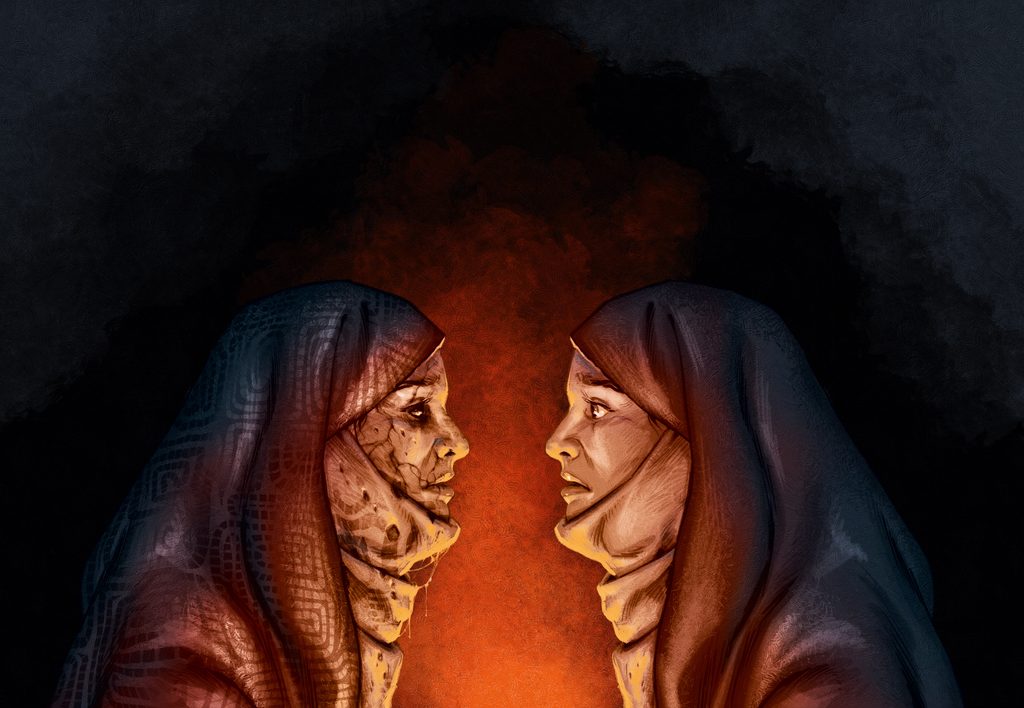
An original story set in the world of Shadows of Nosferatu
*
The rain had fallen for six days without mercy, sometimes in hard silver sheets that hammered the road until the mud spat back at the sky, sometimes in a fine, needling drizzle that seemed worse because it never truly announced itself and never truly ended, only seeped into wool, leather, timber and skin until everything felt cold from the inside. By the time Ilona reached the village of Vranek, the road had ceased to resemble a road at all. It had become a black channel of churned clay and standing water, scored by wagon wheels, hoofprints and the deep grooves left by carts heavy with the dead. Thin streams ran down from the plague pits on the hill above, carrying grey ash, scraps of rotten cloth and little pale fragments that turned slowly in the current. Ilona watched one catch against the edge of a rut, roll free, and expose the smooth white curve of a child’s finger bone. She looked away, although she could not have said whether the gesture belonged to the woman she had once been or to the creature who still remembered how that woman should have behaved.
She smelled Vranek before she saw its first roof. The wet wool wrapped across her mouth and nose was an old human habit and nothing more. It could not protect her from a world that had become painfully vivid since Orlock remade her. Rot had worked its way into the country itself, into the soaked hedgerows and abandoned fields, into the ditches where bodies had been pushed aside to clear the road, into carts left to sag beneath rainwater because the families who owned them were either dead or too frightened to return. She smelled opened flesh, damp straw, smoke from green wood, human waste washed from yards into the street, and the sharp medicinal reek of vinegar splashed across doorways and window frames by people who believed pestilence might be confused by sourness. There was fear in the village too. She could smell that now, though she hated admitting it. Sweat gone bitter beneath dirty clothes, the musk of sleepless bodies, the stale breath of people who had spent too many nights whispering prayers into the dark.
And beneath all of it was blood.
Not the cold, thinning blood of the corpses on the hill, nor the dark residue drying beneath overturned carts, but living blood moving through living bodies. Warm. Salted. Rhythmic. Hidden behind skin and linen and bone, yet impossibly present to her. She could distinguish one heartbeat from another before she could make out the houses through the rain. An old man somewhere beyond the wall whose pulse dragged and stumbled. A fevered woman whose heart raced too quickly. A child breathing hard enough that each beat seemed to tremble in the air.
Ilona closed her eyes for one dangerous moment.
The hunger answered immediately.
It did not arrive as pain. Pain would have been easier. It came as recognition, as though every pulse in Vranek were calling her by a name she had spent years trying to forget.
She could hear them as well whenever the wind weakened, not as a single sound but as a hundred private rhythms concealed behind shutters, under blankets, inside rooms where frightened families had gathered close enough to share one another’s breath. Some hearts beat fast and shallow with fever. Others stumbled with age, paused, then resumed with stubborn little kicks. Children’s pulses fluttered like trapped birds. Somewhere beyond the wall a woman was crying so quietly that no human ear would have noticed, yet Ilona heard the wet catch of each breath and the frantic hammering beneath it. Every life in Vranek announced itself to her whether she wanted it to or not. Blood moved with a soft internal rushing, warm pressure forced through arteries that lay only a few fingers beneath the skin, and as she listened, hunger stirred low in her body with the patient confidence of something that had never once doubted she would eventually submit. It did not plead. It did not threaten. It merely waited, because hunger had learned long ago that even guilt became weak when starved long enough.
Petru rode at her side with his hood thrown back despite the rain, as though weather were an inconvenience meant for lesser creatures. Water slicked his black hair against his forehead, traced the sharp line of his cheekbones and gathered briefly at the tips of his ears before falling to his collar. His skin had the pale, waxy cast of old tallow, but there was colour around his mouth, a dark reddish smear where the shepherd had bled against him at dusk. Petru always fed as though the act amused him. He had dragged the man from beside his flock, laughed when the shepherd began reciting the Lord’s Prayer, and held him upright by the hair while he drank, pausing only when the words became too garbled to understand. Afterwards he had wiped his mouth with the back of his hand and complained that the blood was thin, as though discussing sour wine. Ilona had said nothing at the time. There were days when silence was the closest thing she had left to restraint.
“Orlock sends us to a graveyard,” Petru said. He peered through the rain toward the low wall surrounding Vranek and wrinkled his nose. “Either he is mocking us, or someone has buried something worth stealing.”
Ilona kept her gaze on the road. “He did not send us to the graveyard.”
“He said the dead have stopped lying still.”
“That was not all he said.”
Petru glanced at her. “It was the interesting part.”
“He said the villagers have begun praying to something beneath the church.”
For once, Petru did not answer immediately. He turned his face toward her with an expression that came close to thoughtfulness, as though some part of him were genuinely considering what kind of thing might inspire frightened peasants to kneel before the earth. Then the moment passed. His mouth widened, revealing teeth that had not belonged in a human skull for many years.
“Then perhaps,” he said, “it is a problem for the church to deal with.”
They found the first corpse beside the milestone.
The man had been hanged upside down from an ash tree, not by the neck but by a rope wound tightly around his ankles, leaving his body to sway head-first above the road. His tunic had fallen toward his shoulders and bunched beneath his armpits, exposing a soft, white belly that had been carved with deliberate shallow cuts. The wounds formed a rough wheel, eight lines radiating from a circle around the navel, too careful to have been made in anger and too crude to have been the work of any surgeon. Rainwater had collected in the grooves and diluted what blood remained into faint pink trails.
His throat had been opened from ear to ear.
Six days of weather had washed the skin strangely clean, so that the wound itself looked almost obscene in its clarity. The flesh gaped beneath his chin like a second mouth that had tried to speak and been punished for it. The great vessels had been severed deeply enough that Ilona could see pale cartilage beneath the ragged edges. His beard had been stained a weak rose colour by rain and old blood, and both eyes were open, their sockets filled to the rims with water so that they reflected the grey sky.
Petru reined in his horse.
“Decorative,” he said.
Ilona ignored him.
Someone had driven an iron nail through a rough wooden tablet and into the man’s breastbone. The impact had split the wood down one side, but the word carved into it remained perfectly legible.
HERETIC.
The letters were deep, uneven and furious.
Ilona stared at them for a long moment, then looked toward Vranek.
The village had not killed this man merely to remove him.
Someone had wanted him displayed.
The letters were large, crude and badly formed, each stroke cut so deeply into the wood that pale splinters curled outward from the grain, and as Ilona studied them she could see where the knife had slipped, bitten twice into the same groove, then been forced onward with renewed pressure, which suggested not carelessness so much as a hand trembling under the combined weight of fury, fear and conviction. Whoever had carved the word had wanted it to last. Whoever had stood beneath this tree had wanted anyone coming along the road to understand that the man hanging above them had not merely died, but had been judged.
Ilona swung down from the saddle and immediately sank nearly to the ankle in mud, the road giving beneath her weight with a wet sucking sound as cold water pushed through the seams of her boot, while beside her the horse recoiled from the hanging body with such sudden force that the reins snapped taut in her hand. Its ears flattened against its skull, its nostrils widened, and its eyes rolled until crescents of white showed around the dark pupils, though whether the animal feared the dead man, the smell of him, or some instinctive wrongness that Ilona herself had not yet understood, she could not tell.
She placed one hand against the animal’s neck and felt the muscles trembling beneath the wet hide.
“Easy,” Ilona murmured, though the word felt almost foolish, because the horse had sensed something before either of them had.
She passed the reins across to Petru, who remained mounted for a moment longer, watching the corpse with an expression of mild irritation rather than concern.
Ilona stepped closer to the tree, lifted her face toward the hanging man, and drew in a slow breath.
“Do you smell that?” she asked.
Petru glanced toward her from the saddle. “I smell everything in this miserable place,” he replied, with the same dry irritation he used whenever the world failed to entertain him.
“Not the village,” Ilona said. “Him.”
That made Petru look again.
Ilona moved nearer until the corpse hung almost directly above her, rainwater spilling from its hair, beard and ruined throat, and she separated the scents carefully because she could no longer experience smell as humans did, not as a single impression but as layers that distinguished themselves with painful clarity. There was wet wool, mud, old blood, stale sweat and the mineral stink of road water, yet beneath all of those things there should have been something heavier, something sweet and greasy and unmistakable, the thick odour of flesh softening from within.
There was almost none.
“No rot,” Ilona said quietly. “Not enough for the condition of him.”
Petru’s amusement thinned, and he leaned forward in the saddle before drawing in a breath of his own.
After a moment, Petru said, “You’re right.”
Ilona reached for the dead man’s hand.
The fingers had been cut away at the second knuckle, not with a clean blade or a surgeon’s saw, but by repeated chopping blows that had splintered bone and crushed flesh instead of severing either neatly, while the skin around the stumps had swollen dark and black where blood had pooled before the man’s heart stopped beating. Whoever had done this had not mutilated a corpse.
They had done it to a living man.
Ilona lifted the dead hand a little higher, then looked toward his mouth.
His tongue had been removed as well, though not recently enough for the wound to look fresh. When she tilted his head, she could see the ragged stump deep inside the mouth, thick and dark where it had partly healed, suggesting that the man had lived with the mutilation for some time before anyone cut his throat.
Then she noticed what hung around his neck.
A cord had been threaded through human teeth.
Ilona counted them one by one.
Twenty-seven.
Some were yellowed with age and worn flat by decades of chewing hard bread and tougher meat, others were still white and strong, but three were so small that she did not need to speculate about whom they had belonged to.
Children.
Petru finally dismounted and came closer, boots spreading the mud around his feet as he crouched beside her.
“That is enthusiastic,” Petru said.
Ilona turned her head toward him. “What is?”
Petru nodded toward the teeth. “The decoration.”
“Those came from people,” Ilona said.
Petru gave a small shrug. “Most teeth do.”
Ilona ignored the remark and touched one of the smaller teeth with the tip of her finger, feeling something colder than the rain settle in her chest.
“This was not plague,” she said.
Petru studied the throat more closely. “No,” he answered. “And whatever else happened to him, he has not been dead as long as the village wants us to think.”
Before Ilona could stop him, Petru reached toward the ruined neck.
“Petru,” she warned.
He glanced at her, already smiling again. “What?”
“Leave it alone.”
Petru ignored her, pressed his thumb against the ragged edge of the wound, and pushed aside a fold of cold flesh to examine what lay beneath.
The corpse’s eyes moved.
It was barely perceptible, little more than a shift beneath the rainwater that had filled the sockets, but Ilona saw the gaze roll sideways until it settled directly upon Petru.
She froze.
Petru noticed a heartbeat later.
His expression changed, not into fear exactly, but into a brief and almost comical look of offence, as though the corpse had violated some agreement between the living and the dead by refusing to remain still.
Then the body moved.
It folded violently at the waist with a wet, sudden convulsion, the rope above it creaking as the dead man swung downward, mouth opening wider than seemed possible, and its teeth snapped shut in the exact space Petru’s wrist had occupied less than a second earlier.
Petru recoiled.
“Christ,” he said.
The corpse swung again.
Its mutilated hands closed around Petru’s shoulder with shocking strength, the remaining finger stumps digging into his coat while its head jerked sideways in an attempt to bite through the fabric at his neck.
“Get it off me,” Petru snarled.
He drove his elbow into the corpse’s face.
The nose collapsed beneath the blow with a soft crunch, cartilage flattening against the cheek as one side of the face buckled inward, but the thing gave no cry, showed no sign of pain and only tightened its grip.
One of its ruined hands scraped across Petru’s cheek and left four grey lines through the rainwater and blood.
Ilona seized the corpse by the hair.
The scalp was cold and greasy under her fingers, slick from rain and unwashed skin, and she planted one boot hard against the root of the ash tree before hauling backward with both strength and anger.
The dead man’s head bent farther than any living neck could have survived.
The skin stretched.
The vertebrae beneath it rose like knobs.
Then the first one broke.
Ilona felt the fracture through her hand before she heard it, a hard little click beneath the flesh, followed by another and then another as she dragged the head backward until the neck had become a grotesque bow.
The corpse should have gone limp.
Instead, it thrashed harder.
Its heels struck the tree trunk with enough force to shake leaves loose from the branches, the rope twisted around itself, and a horrible wet rattling came from the opened throat as trapped air pushed through ruined tissue out of some lingering mechanical habit of the body.
Petru caught one of its wrists and tried to tear the hand away from his shoulder.
The grip did not loosen.
“Ilona,” Petru said through clenched teeth, “if you have a better idea, I would appreciate hearing it now.”
Ilona did not answer.
She drove the fingers of her free hand into the dead man’s throat.
The wound widened around her hand with little resistance, cold flesh parting beneath her knuckles while clotted blood and softened tissue slid against her skin, and for a moment she felt only the ugly anatomy of death, the crushed rings of the windpipe, torn vessels and the slick ridges of damaged cartilage.
Then her fingers reached the spine.
She closed her hand around it.
The wound widened around Ilona’s wrist as she forced her hand deeper, the ruined throat offering less resistance than living flesh should have, and something cold, gelatinous and half-rotted slipped apart beneath her fingers before she found the hard ridges of the spine. She hooked both hands around it, braced one boot against the trunk of the ash tree and pulled with all the strength she had spent so many years pretending not to possess.
The neck came apart with a sound like soaked cloth being torn in two.
For a moment the body remained suspended, still twitching against the rope, while the severed head dropped through the rain, struck the mud with a heavy thud, bounced once, and rolled until it came to rest against Petru’s boot.
Its jaw continued to work.
The broken mouth opened and closed with slow, mechanical determination, teeth snapping together on nothing, then opening again as though the body had forgotten that it no longer possessed a throat, lungs or anything else that might give purpose to the motion.
Petru looked down at it, rainwater running from the end of his nose, and his expression shifted from annoyance to something almost resembling admiration.
“Persistent,” Petru said.
He raised one boot and brought it down hard.
The skull collapsed beneath his heel with a soft, brittle crunch, bone giving way like old pottery under pressure, and one eye burst from the socket and rolled wetly into the mud before coming to rest against the edge of a wagon rut. The jaw jerked once, then stopped.
For several seconds, neither of them spoke.
There was only the rain.
It drummed on leaves, struck the road, whispered across the hanging body and filled the gouges carved into the wooden tablet until thin streams of brown water ran through the word HERETIC.
Then a bell sounded from somewhere beyond the village wall.
Once.
Petru lifted his head.
The second toll followed, deeper than the first.
The horses began to back away from the road, trembling so violently that the reins shivered in Petru’s hand, and Ilona saw one animal’s flank quiver beneath its soaked hide as though some instinct older than fear had taken hold of it.
Then the bell rang a third time.
The sound was so low and resonant that Ilona did not hear it so much as feel it enter her body, travelling upward through the mud, through the soles of her boots and into the hollows beneath her ribs, settling in the empty place where a human heartbeat had once lived. There was weight in the note, something almost physical, as though the sound were being struck not in a bell tower but somewhere beneath the earth itself.
A child began screaming inside Vranek.
It was not the startled cry of someone frightened by thunder or darkness. It was long, raw and desperate, the sound of a small body trapped with something it could neither understand nor escape.
Ilona turned toward the village.
The child screamed until the sound broke apart into breathless little gasps, then resumed, higher and weaker than before.
No door opened.
No woman called out.
No man shouted for help.
No one came to comfort it.
Petru listened for a moment, his earlier amusement gone.
“Cheerful place,” he said.
Ilona looked at him. “You can leave.”
Petru gave her a faint smile. “And miss whatever does this?”
He nodded toward the village gate.
Only then did Ilona see the men.
The gate stood open beneath the rain, but the guards who should have been posted there had not abandoned their duty. They had been fixed to it.
Three men had been nailed upright against the timbers with carpenter’s spikes driven through their palms and feet, their bodies arranged with a grotesque care that made the display feel ceremonial rather than merely cruel. Their bellies had been opened from breastbone to groin, the abdominal walls peeled apart and packed with coarse salt, which clung in white crystals to exposed flesh and dissolved slowly in the rain. Someone had drawn their intestines from the wounds and arranged them across the oak planks in careful loops, each curve almost symmetrical, like garlands hung inside a chapel for a feast day.
The comparison came to Ilona before she could stop it.
That disturbed her more than the bodies.
Rainwater travelled down the gate in thin pink rivulets, carrying blood, salt and diluted filth into shallow pools beneath the men’s dangling feet.
One of them was still alive.
His head rested against the timber at an angle that suggested exhaustion rather than injury, and his skin had the translucent yellow-grey colour of wax left too close to a fire. His lips were cracked. His eyelids barely moved. Every breath came from somewhere deep in his chest with a faint bubbling noise, as though fluid had begun to fill the spaces meant for air.
When Ilona approached, his eyes found her.
There was no fear in them.
That absence frightened her.
Fear at least suggested that a man still believed something worse might happen.
This one looked as though he had already learned otherwise.
His mouth moved.
At first, no sound came.
Ilona stepped closer.
The man’s lips trembled again.
“Water,” he whispered.
Petru looked toward Ilona, one eyebrow lifting as if the request had amused him.
“He is nailed to a gate with his insides on display,” Petru said. “I admire his priorities.”
Ilona ignored him.
She returned to the horse, pulled a leather flask from the saddle and uncorked it before coming back to the dying man. When she lifted it toward his mouth, he tried to raise his head but lacked the strength, so she supported him gently at the jaw and tipped only a little water between his lips.
The gesture awakened something uncomfortable in her.
She had done this before.
Not here.
Not as this.
In another life, in another body, she had held cups to the mouths of fevered children and wounded soldiers, had wiped sweat from faces, had whispered lies about recovery because sometimes a merciful lie was the only medicine she possessed.
The man swallowed once.
Then he coughed.
Most of the water came back across Ilona’s hand in a red spray, warm enough to make the hunger inside her stir instantly.
Her fingers tightened around the flask.
The blood smelled different because it belonged to a man who was dying. There was salt in it, sickness, the metallic richness of blood mixed with the sourness of pain and infection.
For one terrible second, she wanted to taste it.
The thought arrived before disgust could stop it.
Ilona lowered her hand.
The man began to cry.
Not loudly.
There was no strength left in him for that.
Tears simply gathered in the corners of his eyes and travelled slowly across his temples into his wet hair, and the shame in his expression was almost worse than the suffering because he looked embarrassed that his body could still produce anything as useless as tears.
Ilona leaned closer.
“Who did this to you?” she asked.
The man stared at her as though trying to remember whether the question belonged to a world in which answers still mattered. The man’s gaze drifted past her toward the church tower rising above the rooftops.
“The faithful.”
His voice was so weak she might have mistaken the words if she had still been human.
“Whose faithful?”
The man tried to answer. His jaw trembled. His tongue moved behind broken teeth, but breath failed him.
The bell sounded again.
His whole body stiffened.
One of the spikes tore through his palm as he convulsed, splitting flesh between two bones. He did not appear to feel it. His back arched from the gate. His mouth opened so wide that dried skin tore at both corners and fresh blood ran down his chin.
“Saint Veyra,” he gasped. “Saint without a face.”
Petru drew his knife.
“Wait,” Ilona said.
The blade went neatly through the man’s eye before the word had finished leaving her mouth. Petru pushed until the point struck the back of the socket. The man’s body sagged against the spikes.
Ilona turned on him.
“Why?”
Petru drew the knife free with the same casual efficiency he might have used to pull a thorn from his coat, then wiped the narrow blade against the dead man’s tunic until the worst of the blood had been absorbed into the already filthy wool. He did not look at Ilona while he cleaned it. His attention remained on the body nailed to the gate, watching the man’s final shudder travel through his limbs as though death were merely another small curiosity the village had provided for his amusement.
“He was finished,” Petru said.
Ilona stared at him, first at the knife in his hand and then at the dead man’s face, where the last traces of expression had not yet disappeared.
“He was speaking,” Ilona replied.
Petru glanced down at the blood running along the man’s ruined belly, then turned his eyes toward her with a faint shrug. “Now he is leaking.”
The answer was so effortless, so perfectly Petru, that for an instant Ilona did not trust herself to move.
She imagined taking the wrist that held the knife and bending it backward until the bones broke through the skin, then imagined catching him by the throat before surprise had left his face and squeezing until cartilage collapsed beneath her fingers. She saw herself dragging him toward the gate, lifting him against the timber beside the men he had found so amusing, and driving one of the carpenter’s spikes through his palm while he was still strong enough to curse her. She imagined opening his throat afterward, slowly rather than mercifully, and leaving him there to greet the sunrise, just to discover whether Petru would still find something clever to say when the first light began cooking the flesh from his bones.
The image came with such speed and clarity that Ilona frightened herself.
Not because she hated Petru.
Hatred would have been simpler.
It frightened her because some part of her wanted to do it.
Daemonia stirred.
There were times when mortals imagined evil as a voice whispering from somewhere beyond them, a devil perched behind the shoulder offering temptations that could be resisted simply by refusing to listen, but Ilona knew better than that now. Daemonia had never spoken to her. It did not need language. It existed as a pressure behind her eyes and a slow heat travelling upward through her spine, as a second pulse moving beneath flesh that had not carried a true heartbeat since the night Orlock changed her, and whenever anger or fear opened even the smallest crack in her restraint, it was there, waiting patiently on the other side.
Her fingers flexed.
Strength flooded into them.
Not the strained strength of muscle and effort, but something effortless and terrible, a certainty that her body could accomplish whatever violence her thoughts proposed if only she permitted it. She looked at Petru’s skull and understood exactly how fragile it was. She could see the shape of it beneath the pale skin, the temples where bone narrowed, the jaw hinged beneath the ears, the vulnerable base where the spine entered the skull.
She knew, with an intimacy that disgusted her, precisely where to place her hands.
Petru noticed her staring.
He slid the cleaned knife back into its sheath.
“What?” Petru asked.
Ilona said nothing.
Petru’s eyes narrowed slightly, and for once there was no smile in them. “Ilona.”
Still she did not answer.
The power continued gathering beneath her skin, warm now, almost comforting, because Daemonia never demanded that she struggle with anger, grief or uncertainty. It offered something much kinder.
Simplicity.
Petru had angered her.
Petru was within reach.
Petru could be broken.
All she needed to do was stop pretending those three facts did not naturally belong together.
Ilona curled her hands into fists.
“Do not,” she said quietly.
Petru tilted his head. “Do not what?”
“Speak.”
That brought the smile back.
“A dangerous request.”
Ilona looked directly at him then, and whatever Petru saw in her expression caused the smile to falter before it had fully formed.
“I mean it, Petru,” she said. “Not another word.”
For several seconds he obeyed.
The rain whispered over the gate behind them, washing thin strands of blood from the dead man’s clothes while Ilona concentrated on the cold water touching her face, the mud beneath her boots and the frightened breathing of the horses, fixing her attention on anything that belonged to the physical world rather than the seductive certainty building inside her.
Gradually, the pressure behind her eyes eased.
Her fingers loosened.
Daemonia did not leave.
It never truly left.
It merely withdrew to whatever dark place inside her had learned patience, content in the knowledge that sooner or later there would be another insult, another frightened heartbeat, another moment when anger would make violence seem less like a choice and more like the most reasonable thing in the world.
Petru watched her carefully now.
When he finally spoke, his voice had lost some of its humour.
“You really were considering it.”
Ilona turned away from him and looked toward the open gates of Vranek.
“Considering what?”
Petru gave a quiet laugh, but there was uncertainty in it this time.
“Killing me.”
Ilona started toward the village.
“No,” she said.
She allowed three steps to pass before adding, without looking back at him, “I was deciding how long it should take.”
She remembered another pair of hands instead.
Her own, long ago, cracked and reddened from lye soap and winter water as she carried bowls through the monastery hospice. She remembered a feverish little girl clinging to two of her fingers because the child’s mother had already died and there was no one else to hold. She remembered closing the eyes of soldiers, beggars, wives and children. She remembered whispering prayers she had believed then, not because she had expected miracles, but because sometimes words were the only mercy left to give.
Mercy had been her virtue.
Now it was a memory she used to wound herself.
“Do not waste another life while I am questioning it,” she said.
Petru sheathed the knife. “You say that as if lives are not the only currency we spend.”
Inside the walls, Vranek had become a slaughterhouse disguised as a village.
Black crosses marked doors where plague had entered. Some houses had been boarded shut from the outside. Scratching came from one as they passed. Bodies lay beneath awnings to keep the rain from them, though no one seemed concerned by the dogs pulling at their hands. A woman knelt beside the well and carved narrow strips of flesh from her own forearm with a kitchen knife, dropping each piece into a wooden bucket while she murmured a prayer. The cuts ran from wrist to elbow in parallel red channels. She did not look up.
At the far end of the street, three boys dragged a priest’s corpse by the ankles. His tonsured skull struck the cobbles every few feet. Each impact made them laugh.
One boy noticed Ilona watching.
He put one finger to his lips.
“He kept secrets,” the boy whispered.
Then he dragged the priest onward.
“Charming people,” Petru said.
Ilona heard a door close behind them.
Another opened farther ahead.
Faces appeared briefly behind shutters, pale and expressionless. None of them looked directly at Ilona or Petru for long.
All of them looked toward the church.
Its doors stood open.
Hundreds of candles burned inside. Their light trembled across a congregation packed shoulder to shoulder in absolute silence. The smell reached Ilona before she crossed the threshold: wax, incense, wet wool, sweat, old stone and blood, so much blood that her mouth filled with saliva.
At the altar stood a woman in a white veil.
She held a human face in both hands.
It had been removed in one piece. The eyelids were still attached. The lips sagged open. Along the edges, where the knife had passed beneath the skin, little curls of yellow fat clung like wax.
The woman raised it toward the crucifix.
“Another gift,” she said.
The congregation answered together.
“Make us clean.”
Ilona entered first.
Wet boots whispered across rushes dark with old blood. As she moved between the pews she saw that every worshipper had removed something from themselves. A man held three fingernails in his palm. An old woman had cut away one ear and tied the wound shut with black thread. A boy no older than ten had sliced the tip from his tongue and placed it in a little wooden bowl. A farmer had removed two toes. A young mother clutched a sleeping infant against her breast while blood from a missing little finger soaked the child’s swaddling.
Some wounds were bandaged with clean linen.
Others leaked freely.
The scent of it struck Ilona like heat from an opened oven. She swallowed. Hunger tightened around her thoughts.
The woman at the altar lowered the stolen face.
“You are late,” she said.
Petru gave a quiet laugh. “We were not invited.”
“You were called.”
“By whom?”
The woman pointed toward the floor.
The bell sounded again.
Now Ilona understood that it did not come from the tower.
The sound came from beneath them, vast and muffled, like iron struck at the bottom of a grave.
The congregation began to sway.
Not together at first. One body, then another, then rows of them, until the entire church moved with a slow rhythm that made the candle flames shiver.
Ilona looked toward the altar. Beneath it, cut into the flagstones, was a narrow stair descending into darkness.
“Who is Saint Veyra?” she asked.
The woman smiled. Her own face was beautiful in the fragile way of the sick, all sharp cheekbones and fever-bright eyes. She could not have been more than thirty. Blood had dried in one nostril.
“She suffered so that we might be spared.”
“Spared from what?”
“The pestilence.”
Ilona glanced over the mutilated worshippers. “It appears to be doing excellent work.”
A murmur moved through the pews.
The woman’s smile disappeared.
“The plague takes flesh because flesh is corrupt,” she said. “It swells us, blackens us, opens us and feeds upon us. Saint Veyra taught us to give willingly what God would otherwise steal. A finger given is a hand spared. An eye surrendered is a soul seen. Blood offered is blood the pestilence cannot claim.”
“And the people on the gate?”
“They refused purification.”
Petru leaned close enough that only Ilona should have heard him.
“I like this saint.”
“I know.”
The butcher attacked from behind.
Ilona heard his heartbeat change before she heard the cleaver leave his belt. She ducked as the blade hissed over her hair, seized his wrist and slammed his elbow down against the carved edge of a pew.
The joint opened with a dry pop.
White bone punched through the inside of his arm.
He stared at it for half a second, as though the exposed hinge belonged to someone else, and then he screamed.
Ilona twisted.
His own hand came backward. The cleaver entered the corner of his mouth and split the cheek to the molars. Teeth skittered across the rushes. He made a high wet sound and tried to pull away, but she drove the blade deeper until its edge struck the bone beside his nose.
Then the church erupted.
The congregation did not scatter.
They came forward.
Petru vaulted a pew and landed among them with delighted savagery. His knife slid beneath a man’s chin and came out below the ear. He ripped it sideways. Blood sheeted down his forearm. A woman seized him from behind, shrieking a prayer into his neck. He caught her by the throat and hurled her into a stone pillar hard enough that her spine broke with a sound like a broom handle snapped over a knee.
Ilona drove toward the altar.
Hands caught her cloak, her hair, her sleeves. Fingers hooked inside her collar. Someone struck her temple with a wooden mallet. Another drove a carpenter’s nail through her left palm and into the back of the pew.
Pain flashed white.
Daemonia answered.
The world sharpened.
She smelled individual people now. Garlic on one man’s breath. Milk on a woman’s blouse. Fear-sweat between the shoulder blades of a boy holding a kitchen knife. She heard teeth grinding, tendons straining, the tiny fluttering beat in the throat of the young mother who had left her infant somewhere among the pews.
Power offered itself without judgement.
Ilona stopped being careful.
She tore her hand free. The nail ripped sideways through the flesh between two metacarpals. She caught it between her teeth, yanked it out and spat it into a man’s eye. He screamed and reached for his face. She seized him by the back of the skull and drove his forehead into another attacker’s face. Once. Twice. On the third impact one skull collapsed above the eyebrow and a soft grey clot of brain matter slid down the man’s cheek.
Someone bit into Ilona’s shoulder.
Human teeth tore through cloth and found flesh.
Ilona turned, hooked two fingers beneath the woman’s lower jaw and pulled.
The joint resisted for a fraction of a second.
Then it gave.
The jaw came away in a wet red hinge. The woman’s tongue dropped forward, thick and useless. Blood pumped over Ilona’s wrist in warm rhythmic bursts.
One drop struck her lower lip.
She tasted it.
That was the mistake.
The woman was terrified. Terror changed the blood, sharpened it, salted it with panic. Ilona could smell every living body in the church now as if each one were an opened cup.
The hunger opened inside her.
She tried to remember the hospice.
She tried to remember the child holding her fingers.
Someone struck her across the back.
A man shouted, “Cleanse her.”
Someone else screamed, “Saint Veyra sees us.”
Ilona seized the nearest body and bit through the throat.
Warmth filled her mouth.
Everything after that became easier.
When she could think again, she was kneeling among pieces of people.
The church had gone quiet except for the soft patter of blood falling from the altar steps and the faint crackle of candles burning down toward their holders. Smoke hung beneath the rafters. The floor was so slick that rushes floated in red water.
Petru stood near the crucifix with half a man’s scalp hanging from one fist. Three knife wounds crossed his chest. One was deep enough to show a pale glimpse of rib, but even as Ilona watched the edges pulled together into narrow red seams.
He studied her face.
“Feel better?”
Ilona looked down.
A young man lay across her knees. She remembered his hands striking at her shoulders. She remembered his voice saying please. She had opened him from collarbone to stomach and fed while he was still trying to push her away. His intestines bulged through the wound beneath his tunic. His fingers were locked around her wrist with such force that his nails had cut crescents into her skin.
She released him slowly.
“No.”
“You always say that.”
The bell tolled beneath the church.
The dead man on Ilona’s knees inhaled.
It was a shallow, rattling breath, impossible in a chest already opened beneath the ribs.
Ilona recoiled.
His abdomen was empty enough that she could see the pale curve of the spine through the ruin she had made, yet he turned his head and looked directly at her. Blood filmed his teeth.
“Clean,” he whispered.
Around the church, bodies began to move.
One man rolled onto his elbows though his neck hung loose. The woman with the missing jaw crawled beneath a pew, fingers slipping in her own blood. A child sat upright and began trying to push an exposed loop of intestine back inside his belly with both hands.
Petru’s amusement disappeared.
“That,” he said, “is inconvenient.”
The woman in the white veil was still alive behind the altar.
She had lost part of her scalp. One eye hung against her cheek on a cord of tissue. She dragged herself toward the stair with both hands, leaving a wide smear behind her.
“Saint Veyra,” she sobbed. “Protect us.”
Ilona caught her ankle.
The woman kicked wildly. Her heel struck Ilona’s wrist.
“Do not touch me.”
“What is below?”
“Grace.”
Ilona tightened her grip. Bones shifted beneath the skin.
“What is below?”
“Grace.”
Ilona squeezed harder until the ankle gave with a grinding crunch.
The woman’s scream climbed into the rafters.
“What is below?”
“A martyr,” she shrieked. “A martyr, you damned thing.”
Petru crouched beside them, one hand pressed against the worst wound in his chest.
“There,” he said. “We are making progress.”
They dragged her down the stair.
The temperature changed almost immediately.
Above them the church had been warm with bodies, blood and candle smoke. Below, the air became cold enough that water beaded on Ilona’s eyelashes. The smell changed too, losing the sweetness of fresh blood and taking on wet earth, mould and something mineral, something like old coins held too long in a dead man’s mouth.
The stair descended farther than the church foundations should have allowed.
“How deep?” Petru asked.
The veiled woman began to laugh.
Ilona yanked her forward by the broken ankle. “Answer him.”
“Deeper than your master’s reach.”
Petru glanced at Ilona. “That sounds optimistic.”
Roots pushed through the walls. Between them were bones, not scattered randomly, but stacked with deliberate care. Femurs lay in horizontal rows. Ribs had been woven into arches. Small skulls occupied niches at regular intervals, each facing inward toward the stair.
Some still had hair.
At the bottom stood a circular crypt.
Its walls had been built from black stone older than the church above. Water ran in thin lines down the mortar. In the centre was a stone coffin bound with iron chains.
There was no bell.
Yet the tolling came from inside the coffin.
The veiled woman began laughing harder.
“You came because she wanted you.”
Petru drew his knife.
“If she wanted me, she could have sent a prettier invitation.”
Ilona approached the coffin.
Each chain link had been engraved with prayers so small that a human would have needed to hold a candle close to read them. Most had been scratched through. Some had been gouged so deeply that the iron had nearly split.
“When was this opened?” Ilona asked.
“Never.”
“Then how did she teach you?”
The woman’s remaining eye widened with such absolute devotion that Ilona felt a chill unrelated to the crypt.
“In dreams.”
Another toll sounded.
Dust drifted from the ceiling.
The coffin lid jumped against the chains.
Petru took one step backward.
Ilona did not.
She placed her palm against the stone.
Something moved beneath it.
Not one body shifting in confinement. Many small movements. Soft brushes. Scratching. Tiny hard points tapping at the underside of the lid.
Petru’s voice lost some of its mockery.
“Whatever is in there, Orlock knew.”
“Of course he knew.”
“Then why send us?”
Ilona looked toward the stair.
The first of the butchered villagers had reached the top step and was crawling downward on broken elbows. Behind him came others, necks twisted, bellies open, jaws hanging, their bodies obeying something more powerful than death.
Ilona looked back at Petru.
“To see which of us came back.”
The chains snapped on the third toll.
One link struck the wall hard enough to chip stone. Another whipped past Ilona’s face and buried itself in the mortar.
The coffin lid rose a finger’s width.
Black fluid poured from the gap, thick as tar and warm enough to steam in the cold air. White worms writhed in it, blind and translucent, twisting over one another as they spilled onto the floor.
Petru seized the stone edge and tried to force it down.
“Help me.”
Ilona joined him.
For one heartbeat they held it.
Then something beneath the lid pushed upward.
Petru left the ground.
He flew across the crypt and struck the wall shoulder first. A shelf of skulls collapsed around him. They burst against the floor like dropped pottery, teeth skittering through the black fluid.
The lid slid aside.
Inside lay the remains of a woman who had been dead for centuries.
Her body was wrapped in linen gone brown with age and bound at the joints with silver wire. Her hands rested upon her chest.
Ilona stared at the fingers.
Each had been cut away.
In their place, someone had attached the finger bones of infants, tiny joints connected with red thread and strips of dried sinew. The hands looked delicate at first glance, almost ceremonial, until the little bones flexed.
Where the woman’s face should have been there was only skin.
No eyes.
No mouth.
No nostrils.
Pale unbroken flesh stretched tightly from brow to chin.
The thing sat up.
The dead villagers crowded the stair.
“Saint Veyra,” they whispered.
Every voice spoke at exactly the same moment.
The faceless head turned toward Ilona.
Words entered her mind without sound.
Give me your face.
Her skin tightened.
At first it felt like cold air drying wet flesh.
Then the pull began.
Ilona screamed.
The skin along her jaw slid forward. Her lips stretched until the corners split. Flesh tore at both temples. She clawed at her cheeks and felt them moving across the bone as though invisible fingers had slipped beneath the skin and were peeling her alive from the inside.
Petru lunged.
His knife entered the saint’s chest to the hilt.
The corpse touched him once.
His face opened.
Not like a cut. Not like any wound made by steel.
The flesh divided from the centre outward in four wet petals. One split ran through his forehead. Another divided the bridge of his nose. His cheeks peeled sideways from the teeth. His chin tore downward.
Petru staggered backward and made a choking sound through a mouth that no longer had proper lips. Blood ran over his teeth and down his neck. His gums were exposed all the way to the molars.
Ilona pushed through the pain and reached for Daemonia.
Power came immediately.
It always did.
That was the seduction.
No prayer had ever answered her so quickly.
No saint had ever given so freely.
Fear became strength. Pain became distance. The dark inside her unfolded like wings and the crypt seemed suddenly too small to contain her.
She seized Saint Veyra by the throat.
The skin felt dry and thin beneath her hands.
She drove the corpse backward into the coffin.
Stone cracked.
The saint bent but did not break.
Ilona struck again.
The back of the faceless head slammed into the floor of the sarcophagus.
Again.
A fracture opened in the stone beneath it.
Again.
The smooth face split down the centre.
There was no skull beneath it.
No muscle.
No human anatomy at all.
A nest of pale fingers writhed inside the head, dozens of them, some adult, some infant-small, packed together and moving like worms in rotten fruit. Nails scraped against one another. Knuckles flexed. Several reached through the split skin toward Ilona’s eyes.
She recoiled, then snarled at herself for recoiling.
The fingers stretched farther.
She grabbed the saint by both sides of the head and tore.
The neck separated with a dry fibrous rip.
She held the head in her hands.
The dead villagers shrieked as one.
For an instant Ilona believed she had won.
Then every severed head in the crypt opened its eyes.
The skulls on the floor turned toward her.
The bones packed into the walls clicked against one another.
Whispers came from every direction, hundreds of voices repeating fragments of names, prayers, confessions, pleas.
Petru, his ruined face hanging loose, grabbed Ilona by both shoulders.
“We cannot kill it.”
The saint’s head writhed in Ilona’s hands.
Give me your face.
“What does it want?” Petru gasped.
Ilona looked at the mutilated villagers. She looked at the infant fingers. She remembered the face held aloft in the church. The people on the gate. The priest dragged through mud. The teeth worn around the neck of the hanging man.
Not offerings.
Erasure.
“Not worship,” Ilona said.
Petru blinked blood from one exposed eye. “What?”
“Identity.”
Ilona turned toward the veiled woman.
“Who was Veyra before she was a saint?”
The woman smiled through blood.
“No one remembers.”
And that, Ilona realised, was the horror of it.
The creature had not been made holy by being remembered.
It had been made powerful by making everyone else forget.
Ilona did not destroy Saint Veyra.
Instead, while Petru held the crawling villagers back with a broken length of chain, she climbed onto the coffin and began speaking names.
At first they were the names of people she remembered from her mortal life.
“Marta.”
A woman from the hospice who had died in winter with both hands black from frostbite.
The whispering in the crypt faltered.
“Tomas.”
A soldier with an arrowhead lodged beside his spine who had asked Ilona to lie and tell him his wound was small.
The saint’s infant fingers curled inward.
“Eliska.”
A little girl who had held Ilona’s fingers because there had been no mother left to hold.
The corpse shuddered.
Petru stared at her as he kicked a dead villager down the steps.
“What are you doing?”
“Giving them back.”
“Giving what back?”
“The dead.”
Then Ilona spoke the names of the people she had killed since Orlock remade her.
There were fewer than there should have been.
That knowledge hurt worse than the torn skin of her face.
She remembered faces without names. Names without faces. A merchant on a winter road. A nun beneath an orchard wall. A soldier she had fed from while he was still trying to draw his sword. A mother who had told her there were children in the next room.
Some memories came only as taste.
Salt.
Wine.
Fever.
Fear.
Too many had already blurred into the red fog of hunger.
The crypt reacted to every name she could recover.
The whispers weakened.
The bones in the walls ceased moving.
The saint’s stolen fingers folded against themselves.
Ilona seized the veiled woman and dragged her toward the coffin.
“Name the man on the gate.”
The woman spat blood into Ilona’s face.
Ilona took one of her fingers.
“Name him.”
The woman shook her head.
Ilona bent the finger backward.
The first joint broke.
“Name him.”
“Stefan.”
“Again.”
“Stefan.”
The saint convulsed.
A crack spread through the smooth skin of its face.
“The other guards.”
“I do not know.”
Ilona broke another finger.
“You nailed them there.”
“Mihai. And Pavel.”
“Again.”
“Mihai. Pavel. Stefan.”
The whispering fell away in layers.
Ilona forced the woman to name every person she could remember mutilating in Veyra’s service. Some names came quickly. Others had to be purchased with pain. Each time the woman tried to say sinner, heretic or unclean instead of a name, Ilona tightened her grip until language became more valuable than belief.
With every name the saint weakened.
Not because the dead had been avenged.
Not because some merciful God had descended into that buried room.
Because Saint Veyra had fed upon anonymity. Upon bodies stripped of personhood until they became examples, warnings, offerings, meat.
Names gave them back their edges.
Names made them people again.
When the last name was spoken, the corpse collapsed into itself.
The infant fingers dropped from its hands one by one.
The faceless skin shrivelled against nothing.
Black fluid spilled from the coffin and sank into cracks in the floor.
From somewhere very far below them came one final toll, so faint it resembled a heartbeat fading beneath soil.
Then silence.
The surviving villagers fled.
Petru sat against the wall and pressed the pieces of his face together with both hands. The flesh had begun to knit, badly. One cheek joined too high. The corner of his mouth tugged upward into a permanent sneer.
He tested it with his tongue and winced.
“You could have discovered that before she opened me like a purse.”
Ilona looked at him.
“You were the one who stabbed her.”
“It seemed reasonable.”
“It usually does to you.”
He considered that, then nodded. “Fair.”
They climbed from the crypt shortly before dawn.
Rain had stopped.
Smoke drifted over Vranek from houses set alight during the night’s violence. The village smelled of wet ash, blood and the first faint sweetness of bodies beginning to cool. Corpses covered the church floor, some killed by Petru, some by Ilona, others torn apart by their own neighbours after the saint’s hold began to fail.
The young mother was among them.
Her infant cried somewhere beneath a pew.
Ilona stopped.
Petru did not.
She found the child wrapped in bloodstained cloth, alive, red-faced and furious. She stared down at it. The heartbeat was so quick and bright that hunger immediately answered.
Ilona closed her eyes.
For one terrible second she imagined the warmth in her mouth.
Then she picked up the child and carried it outside.
An old woman stood in a doorway across the street. She had lost one ear and two fingers. Ilona held the infant toward her.
“Take it.”
The woman did not move.
“It belongs to Mara,” she whispered.
Ilona looked back at the church.
“Mara is dead.”
The old woman began to cry.
“Then take it because Mara is dead.”
The woman crossed the street slowly and accepted the child.
For a heartbeat her fingers touched Ilona’s.
She flinched.
Ilona understood.
At the church doors she found the young man she had fed upon.
He had not risen again.
His body lay exactly where she had left it, opened beneath the ribs, one hand still crooked as though reaching for her.
Ilona knelt beside him.
His eyes were open.
She closed them.
Petru waited at the bottom of the steps.
“Mercy?”
“No.”
“Regret?”
Ilona wiped dried blood from the dead man’s cheek with her thumb. She tried to remember whether he had spoken before she killed him. She could not.
“Memory.”
They left Vranek as the eastern sky turned the colour of old bruises.
The horses were gone. Petru complained for several minutes, then stopped when Ilona reminded him that one had tried to bite him before they entered the village.
They climbed the hill on foot.
Halfway to the ridge, Ilona smelled another dead thing and reached for her knife.
Then she saw the rider.
He waited beneath a black cloak on a black horse, motionless against the paling sky.
Neither Ilona nor Petru had heard him approach.
Count Orlock’s servant lifted one hand.
A sealed letter rested in his palm.
Petru took it.
“Did he know what was under the church?”
The servant said nothing.
Petru glanced at Ilona. “I dislike him.”
“You dislike silence because it gives you time to hear yourself.”
“That may be the cruelest thing you have said all night.”
Ilona broke the seal.
There was only one sentence inside.
TELL ME WHICH OF YOU PRAYED.
Petru read over her shoulder.
For a few seconds he said nothing.
Then he began to laugh.
The laughter pulled at the badly healed corners of his mouth and opened one wound again. Blood ran down his chin. He laughed harder anyway.
Ilona folded the letter carefully.
“Did you?” Petru asked.
“No.”
It was almost true.
She had not knelt.
She had not spoken God’s name.
She had not asked for forgiveness.
But when Saint Veyra had begun to peel her face away, before Daemonia came and power drowned out terror, Ilona had remembered a prayer from the hospice.
Only four words.
Please do not leave me.
She had not known whom she was asking.
Far behind them, beneath the church where the nameless saint had finally fallen silent, something struck once against the inside of the empty coffin.
Ilona heard it.
Petru did not.
She kept walking.
She did not turn around.
Shadows of Nosferatu Gamefound page
Join our dedicated FaceBook page.