
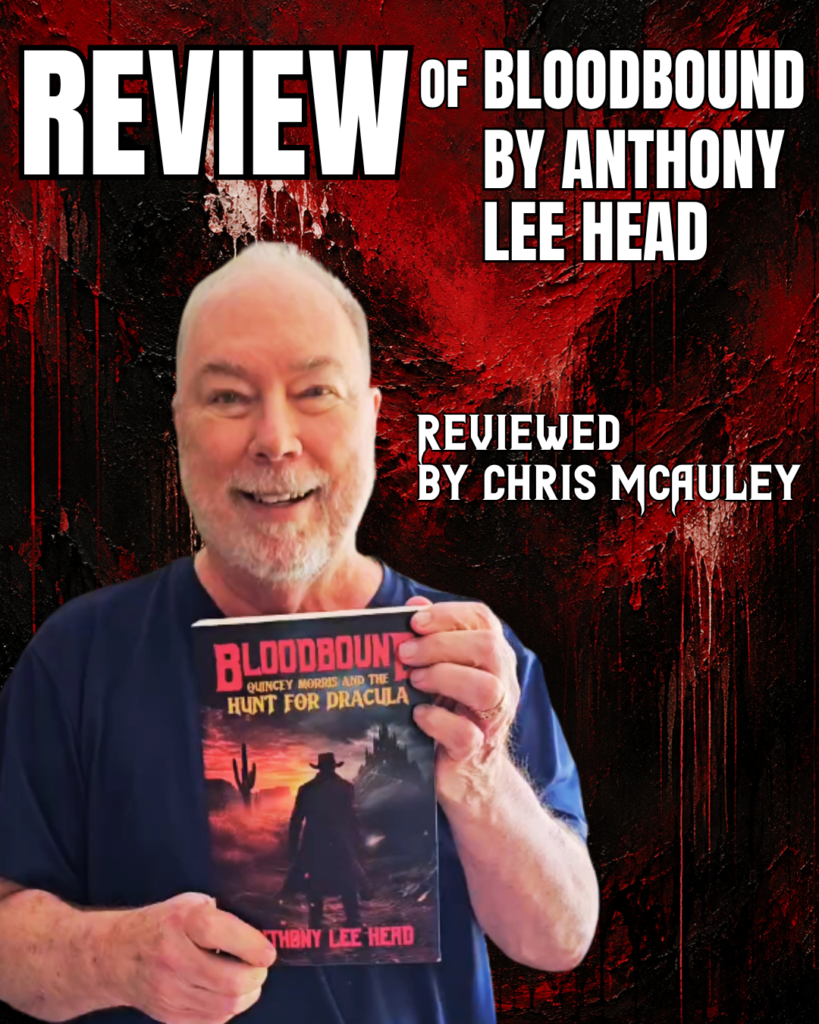
Chris McAuley, co-creator of StokerVerse, gave a detailed review of the book Bloodbound: Quincey Morris and the Hunt for Dracula by Anthony Lee Head.
Chris McAuley is a writer of prose novels, magazine short stories, video and tabletop games and audio dramas. Together with Bram Stoker’s Great-Grand nephew Dacre Stoker, he has created the StokerVerse franchise. He has written the sequel to Dracula which will be released by Scar comics later this year. He has also created a science fiction universe with Babylon 5 actress Claudia Christian. This is coming to fruition in a series of games, novels and comic books. In addition to this he has worked on Doctor Who, Star Wars and most recently the Terminator franchise. Chris has been given the Reggie Bannister award for excellence in Horror writing and is nominated for a similar award in science fiction. He has greatly enjoyed the experience of working with Jeff and Dan, this is his first foray into the world of Lovecraftian poetry.
Here is his review on Bloodbound:
As the co-creator of the StokerVerse, I have spent a considerable part of my creative life exploring the spaces Bram Stoker deliberately or accidentally left in the shadows. That is one of the great strengths of Dracula: beneath the story we all know are characters, journeys and unanswered questions that invite another generation of writers to look more closely. Anthony Lee Head understands that instinct completely, and in Bloodbound: Quincey Morris and the Hunt for Dracula, he takes one of Stoker’s most fascinating yet frustratingly underexplored characters and finally gives him the story he deserves.
Quincey Morris has always been something of an anomaly in Dracula. He is the American who arrives among Stoker’s collection of Victorian gentlemen seemingly carrying the mythology of another literary genre with him: the cowboy, adventurer, hunter and man of action who ultimately plays a vital role in Dracula’s destruction, yet tells us remarkably little about himself. Head recognizes the enormous opportunity contained within that silence. His Quincey is not simply Stoker’s character with several additional chapters bolted onto him; he is reconstructed from the ground up so that, by the time we reach the events familiar from Dracula, his decisions suddenly possess a history, a psychology and, most importantly, an inevitability. Head himself identifies precisely this absence in the original novel, asking who Quincey was, where he came from and what experiences could possibly have prepared him to accept the existence of vampires and willingly hunt one.
The decision to begin in nineteenth-century Texas is inspired. Bloodbound initially feels almost like a supernatural Western before gradually allowing the world of Bram Stoker to close around it. Quincey’s birth beneath extraordinary circumstances, Teresa’s connection to the spirit world, the Cross of Toulouse and the mysterious Bowie knife establish that the supernatural did not suddenly enter Quincey Morris’s life when Abraham Van Helsing began talking about the undead. It has been stalking him since birth. Teresa explains that Quincey’s connection with the unseen allows him to perceive dangers others cannot and marks him as someone capable of standing between ordinary humanity and the things waiting beyond it. It is a clever piece of mythmaking because it answers one of the questions that has always surrounded the character: why does this Texan accept the impossible considerably more readily than almost everyone around him?
What particularly impressed me is that Head does not merely make Quincey important. He makes him Quincey Morris. The Western identity is fundamental to the character. He thinks like a hunter, assesses Dracula like an enemy that can be tracked and cornered, and draws upon experiences completely different from those of Seward, Holmwood, Harker and Van Helsing. At one point, when the others are confronting a supernatural enemy with all the intellectual complications that implies, Quincey reduces hunting to its essentials: find the target, flush it out and bring it down. That difference in worldview gives the familiar Dracula fellowship a new dynamic and makes Quincey’s presence within it feel necessary rather than ornamental.
There is also something much more ambitious happening beneath the adventure. Bloodbound is concerned with inheritance: inherited blood, inherited obligations, inherited prejudice, inherited evil and the question of whether we are prisoners of those things or capable of deciding what we become. Head’s Quincey is a man formed by several cultures and traditions rather than a straightforward Victorian archetype, and his encounters with the supernatural become inseparable from that complicated ancestry. The supernatural material therefore has weight. The Cross, the caul, Teresa’s teachings and the spirits that surround Quincey’s life are not simply pieces of occult decoration; they ultimately converge upon the sacrifice we already know awaits him.
And that is perhaps the book’s greatest achievement. We know where Quincey Morris’s story ends. Anyone familiar with Stoker knows what happens when that Bowie knife finally meets Dracula. Head cannot depend upon surprise, so instead he gives us something more difficult: meaning. When the inevitable confrontation arrives, Quincey’s entire life seems to have been travelling toward that moment. His heritage, his supernatural sensitivity, his experiences as a Ranger, his loyalty to those beside him and his refusal to abandon people he loves all culminate in the man who can look at immortality when it is effectively offered to him and choose sacrifice instead. Suddenly Stoker’s relatively mysterious American is no longer simply the man who happened to have the right knife at the right moment. He is the man who had to be there.
That is why Bloodbound works for me. It does something I believe any expansion of a classic should attempt: it does not try to replace Bram Stoker’s Dracula or explain away its mysteries. It enters into a conversation with it. Head clearly loves the source material, but he loves it enough to ask questions of it, challenge assumptions and explore territory Stoker never had the opportunity to visit. The author describes the novel himself as both a reimagining and an expansion of Stoker’s work, and that distinction is important.
For readers who know Dracula, Bloodbound gives an old friend an extraordinary second life. For readers who love supernatural Westerns, Victorian horror and stories in which mythology collides with history, there is an enormous amount here to enjoy. But for me, as someone who has also spent years asking what might exist beyond the final page of Stoker’s novel, its greatest compliment is a simple one: Anthony Lee Head made me look at Quincey Morris differently.
And after more than a century of Dracula stories, making us see something genuinely new in Bram Stoker’s world is no small achievement.
Chris McAuley
Co-Creator of the StokerVerse
Read more about BloodBound HERE.
Grab your own copy of BloodBound HERE!