The Kennebec runs through the belly of town like a black vein, carrying secrets and silt, chemicals and bones. Jeff and I follow it south, tromping along the Quarry Trail as we do every August before school starts up, the blackflies buzzing in our ears. It’s that time of year when we spit in death’s eye. When I set my jaw and follow Jeff crashing down into that cold, murky water. When we defy the curse that’s plagued our family since it first landed here almost 140 years ago.
My Uncle Jonny was the last one to go. Spring of 2000. Dawn of a new century, twilight of Jonny’s short, hard run. Mum was just fourteen at the time, same age as Jeff and me now. Uncle Jonny wasn’t much older, seventeen or eighteen. Nodded off under the Two Penny Bridge with the needle still in his arm, tipped into the current like he was bowing to whatever dark, thirsty force claims a member of our family each generation.
“Why ya walkin’ so slow, shit stain?”
I pop my head up, realizing Jeff’s way ahead of me. He calls back and waves.
“Got a load in your pants, or what? Still another mile to the trestle—hurry up, Upchuck!”
I can’t imagine that when my parents named me Charles, they could’ve known it would someday, somehow devolve into “Upchuck.” Still, seems like they could’ve gone with something a bit more foolproof.
“I’m comin’, I’m comin’,” I holler up.
“Bet you are, perv berry!” Jeff cackles. “Quit playin’ with yourself!”
Jeff was only born a few minutes before me, but you’d think it was a world or two the way he behaves. Goddamn, but he’s fearless. Not me, I’m scared of everything. School. Girls. Dad. Hell, I’m even scared of Jeff sometimes.
Dad always says he prayed for a daughter but ended up with shit-ass twin boys instead. Back in the old days, they had whole litters of children. Eight, ten, twelve little buggers to chase, to feed . . . to keep away from that river. Great-Great-Grandfather Elias came to work the railroad back in 1891. He and his twin brother Joseph found their way to Central Maine, of all places, from Lebanon, where famine had turned green valleys into graveyards. They weren’t Elias and Joseph then. They had different names, something in Arabic that the man at Ellis Island couldn’t spell. But they loved their new names and their new lives. Even loved the work, though it was hard and dangerous, and though Joseph got his legs crushed in the switching yard three months after they arrived at seventeen years old. Great-Great-Grandfather Elias stood stone still and watched his twin brother roll screaming off the track and into the water, like his fate had been sealed long before. Elias married a Syrian immigrant the next year, my Great-Great-Grandmother Gail, and they went on to have twelve kids. Twelve. Like they planned on losing at least one or two. And they did. Their youngest daughter, Carole, fell through the ice in 1923, chasing a dog.
Some say our curse started with Joseph, but I’ll bet it started earlier. “Long quiet water,” that’s what Kennebec means in Abenaki. The Kennebec people lived on this river for thousands of years. Salmon runs so thick you could cross on their backs, at least that’s what the plaque says at Head of Falls. Summer of 1724, there was a battle at the bend where the trestle bridge stands now. The English slunk upriver at dawn, burned the village, killed the French priest and dozens of Kennebec families. By winter, the Kennebec people were entirely gone from this place.
“You’re jumpin’ first this year, pencil penis.”
“But . . . you jump first every year,” I reply.
“Exactly,” Jeff says.
“We don’t wanna jinx it, do we?” I ask.
“Maybe not . . . shit, I don’t know,” Jeff says. “Here comes the bend up ahead . . .”
Grampy Sam’s generation had eight kids. The Kennebec took Grampy’s younger brother, my Great Uncle Tommy, in 1957. Tommy worked the paper mill like everyone else in those days, pulling twelve-hour shifts while the river ran orange, then blue, then a putrid shade of yellow that stained the rocks and killed everything that moved, and some of the stuff that didn’t. You could smell it all the way to Skowhegan. Rotten eggs and progress, Dad says. Tommy got off his shift one night, already half-drunk, and smashed his Chevy pickup through the guardrail on the Muskie Bridge. Water was so polluted back then that it took a week for his body to float up.
“There she is!” Jeff cries.
The trees break, and I see it. Black iron against blue sky. Ancient and mysterious. Jeff lets out a wild hoot that echoes through the gorge, announcing our presence to every god and demon on dry land or below.
He doesn’t believe in the curse. Says it’s bullshit, says Mum belongs in the loony bin for going on about it, says people drown everywhere all over the world, and it doesn’t mean anything. He hawked a loogie in the river last year, right over the railing, just to prove his point. We watched his phlegm disappear with the current, then the next moment he jumped and—splash!
Jeff’s sneakers touch first, scuffing along the railroad ties. When I step onto the trestle, my legs feel so weak I might crumble . . .
An eagle screams upriver. High-pitched and sweet. Bald eagles started coming back after the river was cleaned up in the nineties. Dad says they used feeding stations stocked with roadkill to help them recover, because they’re the national bird. Piles of deer and moose carcasses, rotting in the sun. Death feeding life. Rotten meat and progress. Maybe that’s America in a nutshell. Anyway, must’ve worked, because the bald eagles, they came back strong.
“Fuck, she’s bony this year,” Jeff says, pointing down from the railing spot where we always jump, our family name carved there in the rust. “Low as a sumbitch . . . gotta hit that pocket clean, or we’ll bust our legs for sure.”
There’s a darker hole in the dark water twenty-five feet directly below us. Looks about the size of a quarter from this height. I stare down at the pocket, the way the sunlight plays off the water’s surface, and a glint of something else below the surface, deeper down . . .
“Welp, who’s goin’ first then?” Jeff asks, already knowing the answer.
“We don’t wanna jinx it . . .” My voice shakes, just a little.
Yesterday was the first time in my life that I ever came out here by myself. Found the busted shopping cart by the homeless camp off Six Rod Road. It was tough going, dragging that thing over the roots and rocks in the Quarry Trail. Probably part of the reason that my legs feel so weak now, but not the full reason.
The ass end of the cart was already all stove up, so I just kind of finished the job with the claw hammer I brought, beating and prying the skinny bars so they stuck up and out. Then I lugged it across the trestle, all puffing and sweating, to the railing spot bearing our family’s name. I heaved it up onto that railing, aiming as best I could, and let her drop. Fell nose-first into the pocket and lodged there like it was placed by God’s own hand.
Jeff climbs up onto the railing now, making a show of his tightrope routine like he always does. “Another year, little bro,” he says to me.
“Here’s to it,” I say, peeking over the edge to glimpse another flash of chrome from down inside the pocket. Something inside my belly curdles.
“I love ya, Upchuck.” Jeff stares down at me with that sparkle in eyes. So goddamn brave. Invincible.
“Love you, Jeff,” I say.
Then he steps into thin air—whoosh!
He hits the water, and I shut my eyes. Bile tickles the back of my throat. I count to five, slow as I can manage. When I open my eyes again, I can’t see much. The water’s cloudy with muck, silt, and something else. Looks reddish, and Jeff is still below.
The eagle screams again. Then, just the trickling water. In the quiet moments that follow, I’m surprised as my burden of fear lifts, knowing in the deeps of my soul that it was either him or me. But this relief washes away like Jeff’s blood in the current, because my mind blinks ahead to my own children, knowing that the river will claim one for its tithe, asking whether I’ll let the river decide, or choose.
—
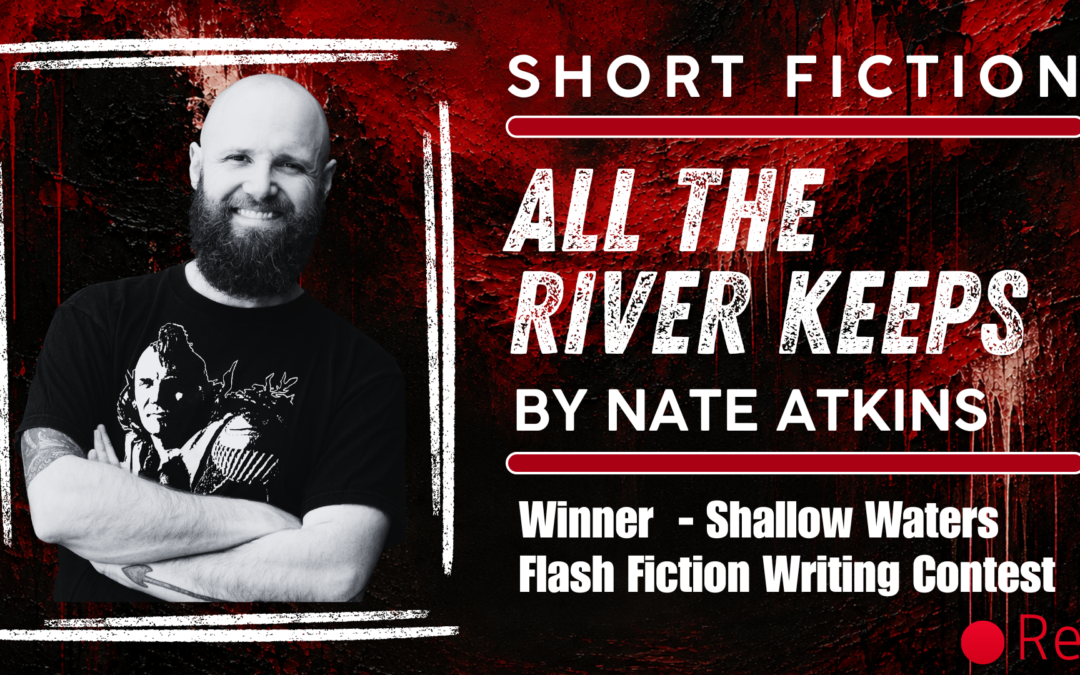
Author Bio: Nate Atkins is a screenwriter, author, wildlife conservationist, and lifelong horror hound whose work explores the ever-shifting boundary between the monster within and the one staring back at us. He has eked out a living by the written word for the past twenty years, with side hustles ranging from cattle necropsies to guiding wilderness expeditions. He grew up in Central Maine and now lives in New York’s Hudson Valley, somewhere between the Rip Van Winkle Bridge and Sleepy Hollow.
Website: www.nateatkins.com
IG: @nightmare_nate666 Facebook: https://www.facebook.com/share/18eFuxvteB/